Block paving is the most popular driveway surface in Chingford and for good reason. It offers more colours, patterns and design options than any other finish, it suits both period and modern E4 homes, and if a block is ever stained or cracked it can be lifted and replaced individually. But the difference between a block-paved drive that still looks superb in twenty years and one that sinks, spreads or grows weeds within three comes down to the block you choose, the pattern it’s laid in, and above all, the groundwork beneath it. This guide covers all of that, with real 2026 costs and the Waltham Forest planning detail most guides miss. Trade Wright Paving & Landscapes lays block paving across Chingford, and this is the advice we give at every survey.
Why block paving is Chingford’s favourite driveway choice
Off-street parking is valuable across Chingford, from the terraces around Chingford Mount to the larger semis near Chingford Green and North Chingford. Block paving delivers secure parking with serious kerb appeal, and its standout practical benefit is repairability: because it’s made of individual units laid on sand, a section can be lifted for a repair or a utility connection and re-laid seamlessly, something you can’t do with resin, tarmac or concrete. Add strong load-bearing performance and decades of lifespan when it’s built correctly, and it’s easy to see why it dominates local driveways.
Types of block paving for Chingford homes
“Block paving” covers several very different materials, and the right one depends on your budget, the look you want and how the surface will be used.
Concrete block paving is the most common and cost-effective choice, available in a huge range of colours, sizes and textures from crisp modern charcoals to tumbled, aged finishes for traditional homes. Premium ranges from brands such as Marshalls, Brett and Tobermore add durability and colour that lasts.
Clay pavers are fired brick pavers prized for colour that never fades and a warm, characterful finish that suits period Chingford properties. They cost more than concrete but keep their looks for decades.
Natural stone setts – granite, sandstone or porphyry, sit at the premium end, delivering a high-end, heritage appearance and exceptional strength, ideal for statement frontages.
Permeable block paving (systems like Marshalls Priora) is laid with special spacer nibs and open joints so rainwater drains straight through into a stone reservoir below. It’s the smart choice on London Clay because it manages surface water and, crucially, usually keeps you clear of planning permission. Explore all options on our block paving service page.
Block paving laying patterns explained
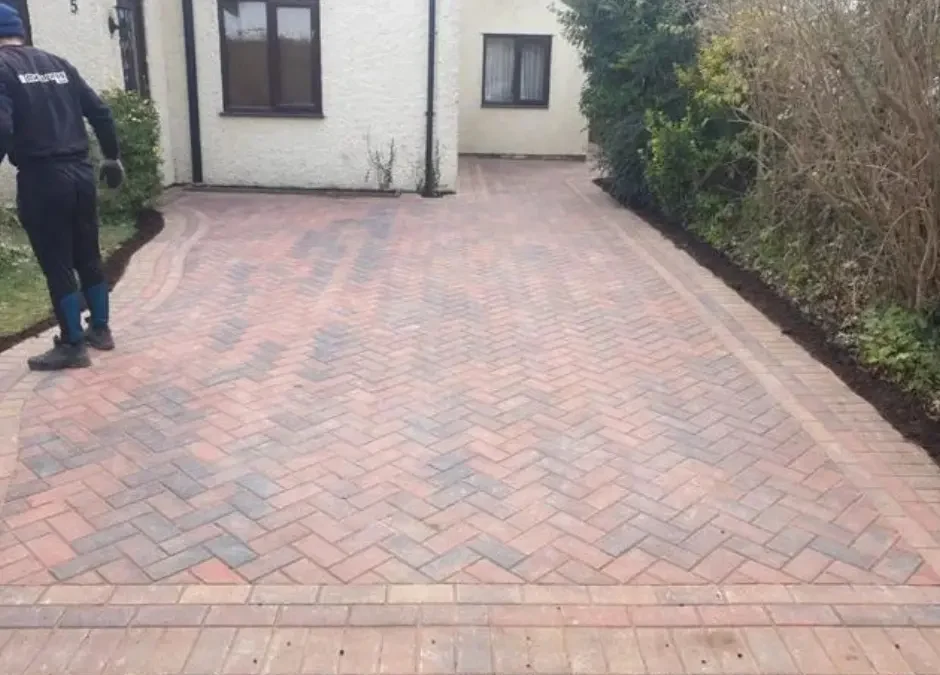
The pattern isn’t just aesthetic, it affects strength. For driveways carrying vehicles, herringbone (laid at 45° or 90°) is the gold standard, because the interlocking bond resists the twisting forces of turning wheels and braking; it’s the pattern specified in the British Standard for vehicular paving. Stretcher (running) bond gives a clean, contemporary look and suits large-format blocks. Basketweave is a classic, traditional pattern best kept for patios and light-use paths rather than driveways. Circles and fans create a striking feature, often combined with a contrasting soldier-course border that frames the drive and locks the edges. We’ll recommend the right pattern for how your surface will be used, not just how it looks.
How much does block paving cost in Chingford in 2026?
Block paving prices in Chingford sit a little above the national average, because London and the South-East typically add 20–30% to baseline costs. The figures below are realistic 2026 installed prices for the E4 area, including a proper sub-base the layer cheaper quotes cut corners on. Permeable systems and natural stone sit at the higher end. Every project still needs a survey for an exact figure, because size, excavation, access, edgings and drainage all move the number.
| Block type | Typical 2026 cost (per m², installed) | Guide price — 50m² two-car drive |
|---|---|---|
| Standard concrete blocks | £100–£140 | £5,000–£7,000 |
| Permeable block paving | £120–£160 | £6,000–£8,000 |
| Premium / tumbled ranges | £130–£170 | £6,500–£8,500 |
| Clay pavers / natural stone setts | £150–£220 | £7,500–£11,000 |
Budget separately for any drainage or groundworks (commonly £600–£1,500) and for a dropped kerb if you don’t already have one (see below). The cheapest quote rarely represents the best value premium blocks laid on a shortcut sub-base will fail long before standard blocks laid properly.
Permeable paving, planning and dropped kerbs in Chingford (Waltham Forest)
Chingford is in the London Borough of Waltham Forest, not Essex, so it’s the council’s rules that apply. For the surface itself, you generally do not need planning permission if the block paving is permeable, or if rainwater drains to a permeable area within your property rather than onto the road. Lay more than five square metres of impermeable blocks at the front without drainage and permission can be required, which is exactly why permeable block paving is such a smart choice locally. See the Planning Portal and the Government’s permeable surfacing guidance.
If you need to cross the pavement to park, you’ll also need a vehicle crossover (dropped kerb). In Waltham Forest the current application fee is £325 (non-refundable), construction is charged at around £400 per square metre, and your front garden must be at least 4.8m deep to park a car, full details are on the Waltham Forest dropped kerbs page. We guide you through the whole process and design the layout to comply.
Why the sub-base decides how long your block paving lasts
This is the part cheaper installers skip. Chingford sits largely on London Clay, a shrink-swell soil that expands in wet winters and contracts in dry summers. That movement is the number-one cause of sinking, rutting and lifting block paving across E4. The blocks on top matter far less than the engineering beneath them. Every Trade Wright drive is excavated to the correct depth, laid over a geotextile membrane and a compacted MOT Type 1 sub-base built up in layers, with concrete-haunched edge restraints around the full perimeter and a designed fall for drainage all to BS 7533, the UK standard for block paving. Skip the edge restraints and the blocks spread and open at the sides within a couple of years, no matter how good they are.
Looking after your block paving
Block paving is low-maintenance, not no-maintenance. The joints between blocks are filled with kiln-dried or polymeric jointing sand, which stabilises the surface and blocks weed growth; it needs topping up roughly every three to five years. An occasional wash keeps colours fresh, and optional sealing adds stain resistance and locks the joints. The repairable nature of block paving is a genuine long-term saving a single oil-stained or cracked block can be swapped rather than resurfacing the whole drive. We leave every customer with a few spare blocks for exactly that reason.
Common block paving mistakes we’re called out to fix
Across Chingford we regularly repair driveways that failed early, and the causes are almost always the same: a sub-base that’s too shallow for clay ground; blocks “spot-bedded” on dabs of mortar instead of a proper bedding course; missing or weak edge restraints; the wrong pattern for the load; and poor drainage that leaves water pooling. Every one of these is invisible on the day the drive is finished and expensive to put right later, which is why the questions you ask before hiring matter more than the price.
How to choose a block paving contractor in Chingford
Vet installers on what you can’t see. Ask whether the quote specifies sub-base depth and material in writing; whether they lay to BS 7533; whether they carry public liability insurance with certificates available before deposit; whether they offer a written workmanship guarantee; and whether they have genuine, recent, named reviews on Google. Avoid cash-only doorstep deals. A reputable local installer will happily show you recent block paving nearby and explain the full build-up, layer by layer.
Areas we cover in and around Chingford
We lay block paving across the whole E4 area, including Chingford Mount, Chingford Green, North Chingford, South Chingford, Highams Park, Friday Hill and Hale End. See more of our work on our Chingford paving page, or read our companion guide to driveways in Chingford if you’re still comparing surfaces.
Start your Chingford block paving project
Whether you know exactly the block and pattern you want or you’d like impartial advice on what suits your home and budget, we’re here to help. Contact us or call 0800 772 0705 for a free, no-obligation survey and a clear written quote.
Frequently asked questions about block paving in Chingford
How much does block paving cost in Chingford? As a 2026 guide for the E4 area, standard concrete block paving runs around £100–£140 per square metre installed, or roughly £5,000–£7,000 for a two-car (50m²) drive; permeable, premium and natural-stone options cost more. A free survey gives you an exact fixed price.
What is the best pattern for a block paving driveway? Herringbone, laid at 45° or 90°, is the strongest and the standard for driveways because it resists the twisting force of vehicle wheels. Basketweave is best kept for patios and light-use paths.
Do I need planning permission for block paving in Chingford? Usually not if the paving is permeable or drains within your property. Impermeable blocks over five square metres at the front, without drainage, can require permission.
How long does block paving last? Laid correctly on a proper sub-base with edge restraints, a block-paved driveway lasts 20–30 years or more, with occasional re-sanding.
Does block paving get weeds? Weeds grow in the joints only when the jointing sand runs low. Topping up the kiln-dried or polymeric sand every few years, and optional sealing, keeps them at bay.
How long does installation take? Most Chingford block paving driveways are completed within 3–7 days, depending on size, ground conditions and any drainage or dropped-kerb work.